

Introduction
Whether you are buying a home, investing in property, or planning a real estate development project, understanding FSI in real estate is essential. FSI plays a crucial role in determining how much construction can be carried out on a particular plot of land. It directly impacts building height, project density, housing supply, and overall property value.
The FSI full form in real estate is Floor Space Index. It is a planning tool used by local authorities to regulate urban development and ensure balanced infrastructure growth. Every city and state in India follows specific FSI regulations based on land use, location, road width, and development policies.
In this blog, we will explore the FSI meaning in real estate, understand the FSI in real estate formula, learn how it is calculated, examine different types of FSI, and understand its significance in the Indian and Gujarat real estate markets.
What Is FSI in Real Estate?
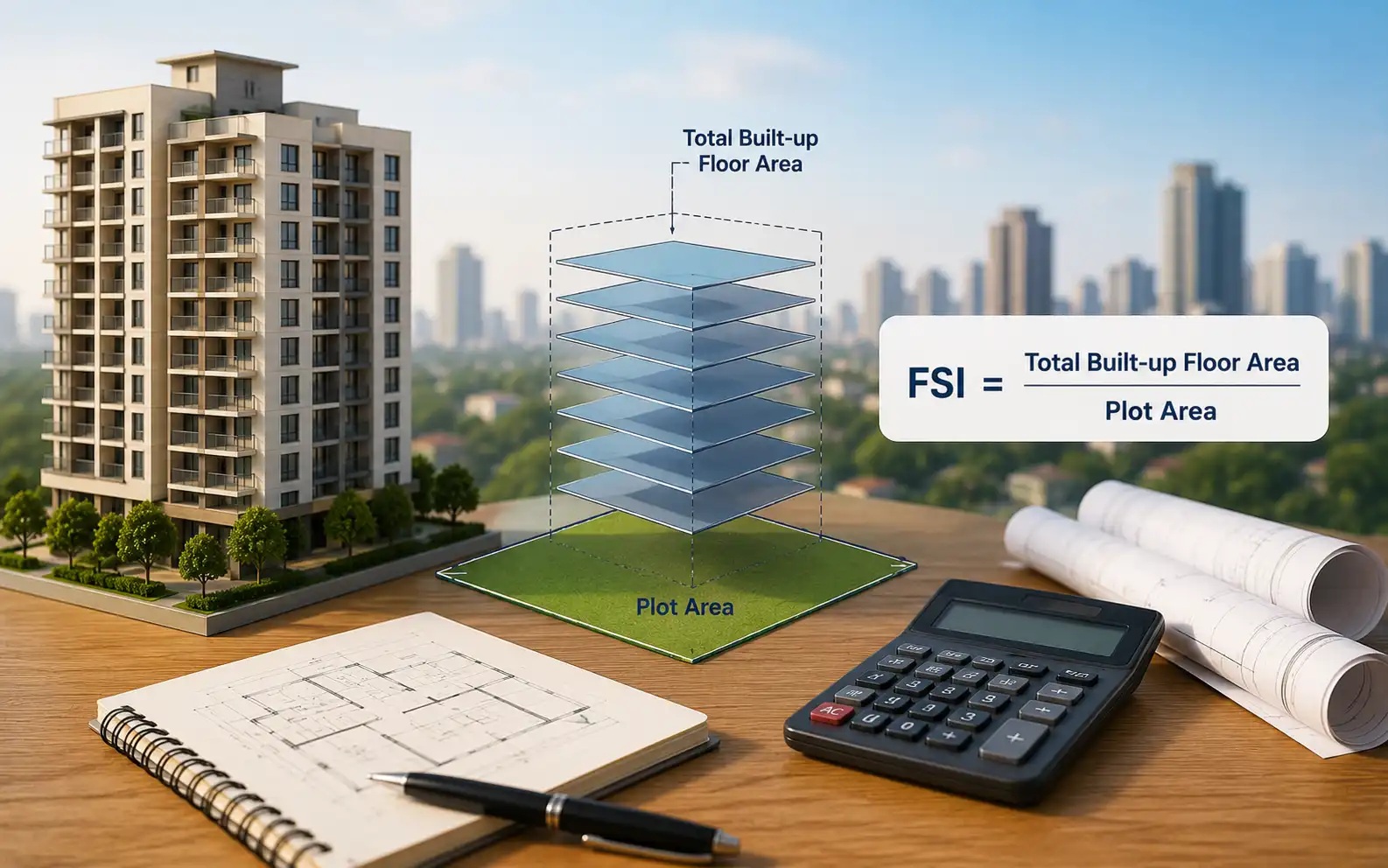
The FSI full form in real estate is Floor Space Index. It refers to the ratio between the total built-up area of a building and the total plot area on which the building is constructed.
In simple terms, FSI determines how much construction is allowed on a piece of land. It is a critical urban planning tool used by municipal authorities and development bodies to control building density and infrastructure utilization.
The FSI meaning in real estate can be understood as a guideline that balances land usage with city infrastructure such as roads, drainage systems, public transport, water supply, and utilities.
For example, if a plot has an area of 1,000 square meters and the permitted FSI is 2.0, the developer can construct up to 2,000 square meters of built-up area on that plot.
Why is FSI Important in Real Estate?
FSI influences nearly every aspect of property development. It determines the maximum construction potential of a land parcel and directly impacts project feasibility.
For developers, FSI helps calculate the number of residential or commercial units that can be built. For homebuyers, it provides insights into project density, open spaces, and future development potential.
Higher FSI generally allows more built-up area, resulting in increased housing supply and improved land utilization. Lower FSI helps maintain lower density developments with more open spaces and better infrastructure management.
FSI also plays an important role in project approvals, valuation, redevelopment opportunities, and urban planning policies.
Understanding Floor Space Index (FSI) with a Simple Example
The easiest way to understand FSI in real estate is through a simple example.
Suppose a developer owns a plot measuring 1,000 square meters.
If the permissible FSI is 2.0, the maximum allowable built-up area will be:
1,000 × 2.0 = 2,000 square meters
This means the developer can construct a total built-up area of 2,000 square meters across multiple floors.
For example:
- Ground Floor = 500 sq. m.
- First Floor = 500 sq. m.
- Second Floor = 500 sq. m.
- Third Floor = 500 sq. m.
Total Built-Up Area = 2,000 sq. m.
This simple example shows how FSI determines the construction capacity of a plot.
What Is the Formula for FSI Calculation?
FSI Formula
The standard FSI in real estate formula is:
FSI = Total Built-Up Area ÷ Total Plot Area
This formula is used by developers, architects, consultants, and planning authorities to determine the permissible construction area.
Components Used in the Formula
Total Plot Area
This refers to the total land area available for development. It forms the base value for FSI calculation.
Total Built-Up Area
Built-up area includes the total floor area constructed across all floors as permitted by local regulations.
Permissible FSI
This is the maximum FSI allowed by local authorities for a particular zone, location, or type of development.
The combination of these factors determines how much construction can legally take place on a property.
What Is Permissible FSI?
Meaning of Permissible FSI
Permissible FSI refers to the maximum Floor Space Index approved by local development authorities for a specific plot or zone.
Every city has different FSI regulations depending on infrastructure capacity, urban planning policies, road width, population density, and future development plans.
For example, premium urban areas often receive higher permissible FSI compared to suburban or low-density zones.
Factors Affecting Permissible FSI
- Location of the plot
- Road width adjoining the property
- Zoning regulations
- Type of development (Residential, Commercial, Industrial)
- Infrastructure availability
- Government development policies
- Redevelopment incentives
- Transit-oriented development plans
These factors collectively determine the development potential of a property.
Types of FSI in Real Estate
Different types of FSI are applicable based on project requirements and development regulations.
Basic FSI
Basic FSI is the standard development potential granted by local authorities without additional premiums or incentives. It forms the foundation for most residential and commercial developments.
Premium FSI
Premium FSI allows developers to purchase additional development rights by paying charges to local authorities. This mechanism helps cities accommodate growth while generating revenue for infrastructure improvements.
Fungible FSI
Fungible FSI provides additional construction flexibility beyond the basic permissible FSI.Developers typically pay a premium to obtain fungible FSI rights.
Incentive FSI
Incentive FSI is granted by authorities for specific development activities such as public amenities, rehabilitation projects, or infrastructure contributions. This encourages developers to participate in planned urban development initiatives.
Redevelopment FSI
Redevelopment FSI is commonly provided for urban renewal projects and redevelopment schemes. It allows developers to construct additional built-up area while replacing older structures with modern developments.
Difference Between Floor Space Index (FSI) vs. Floor Area Ratio (FAR)
Many people assume FSI and FAR are different concepts, but they are essentially the same measurement expressed differently.
FSI is commonly used in India, while FAR (Floor Area Ratio) is widely used internationally.
Both represent the relationship between built-up area and plot area.
For example:
- Plot Area = 1,000 sq. m.
- Built-Up Area = 2,000 sq. m.
FSI = 2.0
FAR = 2.0
The calculation remains identical. The only difference lies in terminology used by different planning authorities and regions.
Benefits of Floor Space Index (FSI)
Better Land Utilization
FSI enables efficient utilization of available land, especially in urban areas where land resources are limited.
Increased Housing Supply
Higher FSI allows developers to create more residential units, helping meet growing housing demand.
Economic Growth
Real estate development contributes significantly to employment, infrastructure development, and economic activity.
Better Urban Planning
FSI helps authorities manage population density while ensuring infrastructure can support future growth.
Reduced Urban Sprawl
By encouraging vertical development, FSI reduces excessive horizontal expansion and promotes sustainable urban growth.
Common Challenges and Misconceptions about FSI
Challenges Associated with FSI
- Frequent regulatory changes create uncertainty for developers.
- Complex approval processes can delay projects.
- Infrastructure limitations may restrict higher FSI utilization.
- Higher FSI can increase construction costs.
- Redevelopment projects often involve complicated FSI calculations.
Common Misconceptions about FSI
- Higher FSI always means better property value.
- FSI directly determines building height.
- All built-up areas are counted equally in FSI calculations.
- FSI regulations are identical across all Indian cities.
- Higher FSI automatically guarantees higher profits for developers.
Understanding these misconceptions helps buyers and investors make informed decisions.
FSI in Gujarat Real Estate Market
The Gujarat real estate market has experienced significant growth due to industrial expansion, infrastructure development, and urbanization.
Cities such as Ahmedabad, Vadodara, Surat, Rajkot, and Gandhinagar have implemented development regulations that use FSI as a key planning tool.
In Gujarat, FSI policies often vary based on zoning classifications, road width, development corridors, and municipal regulations. Strategic infrastructure projects and urban redevelopment initiatives have also influenced FSI utilization across key cities.
For developers, understanding local FSI Regulations in India and Gujarat-specific policies is essential for project planning and feasibility analysis. Homebuyers and investors can also benefit from understanding FSI because it influences project density, open spaces, and future property appreciation potential.
As Gujarat continues to develop, FSI will remain one of the most important factors shaping residential and commercial real estate growth.
Conclusion
Understanding FSI in real estate is important for developers, investors, and homebuyers alike. It determines the maximum construction potential of a property and directly impacts project planning, housing density, property value, and urban development. By understanding the FSI full form in real estate, learning the FSI in real estate formula, and recognizing the different types of FSI, stakeholders can make better real estate decisions.
Whether you are purchasing a residential apartment, evaluating an investment opportunity, or planning a development project, knowledge of FSI helps you assess the true development potential of a property while ensuring compliance with local regulations.
FAQs
1. What is FSI in real estate and how does it impact property development?
FSI determines the maximum built-up area that can be constructed on a plot and directly affects project size, density, and development potential.
2. What is FSI and how is it calculated for residential properties in India?
FSI is calculated by dividing the total built-up area by the total plot area.
3. How is FSI calculated?
FSI = Total Built-Up Area ÷ Total Plot Area.
4. What is the difference between FAR and FSI?
Both represent the same calculation. FSI is commonly used in India, while FAR is more commonly used internationally.
5. What is permissible FSI?
Permissible FSI is the maximum Floor Space Index allowed by local authorities for a particular property or zone.
6. Where can I find consultants specializing in FSI optimization for real estate projects?
Architects, urban planners, development consultants, and real estate advisory firms typically provide FSI-related consulting services.
7. Who decides FSI regulations in India?
FSI regulations are determined by state governments, urban development authorities, municipal corporations, and planning agencies.